

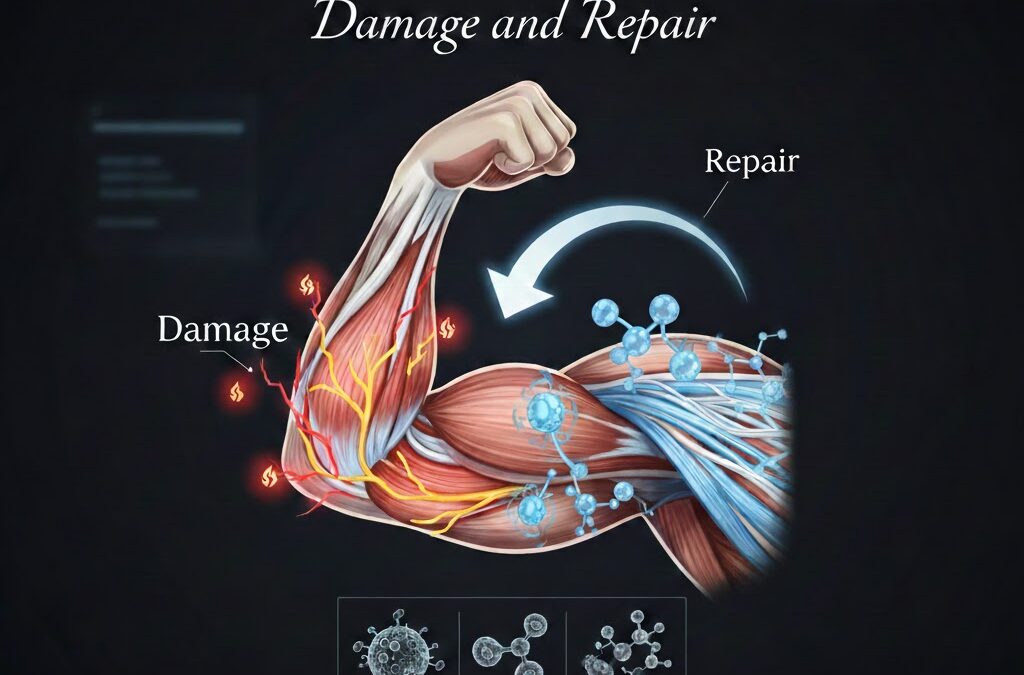
When you perform resistance training or unfamiliar eccentric movements (such as downhill running), your muscle fibers experience structural stress. This process involves three distinct phases:
- Micro-tears
During intense exercise, sarcomeres (the basic units of muscle contraction) undergo microscopic mechanical damage. These micro-tears are not “injuries” in the traditional sense, but rather the necessary stimulus for hypertrophy (growth).
- Swelling, Irritation, and DOMS
Delayed Onset Muscle Soreness (DOMS) typically peaks 24 to 72 hours after exercise. It isn’t caused by lactic acid but by the swelling and irritation response to micro-tears. As the body clears cellular debris, white blood cells migrate to the area, causing the swelling and tenderness we feel as “soreness.”
- Adaptive Repair
The body repairs these tears by fusing muscle fibers to form new muscle protein strands (myofibrils). These repaired fibers are thicker and stronger than before; this adaptive response allows you to lift more weight or run faster over time.
Targeted Ingredients for Recovery
To optimize this cycle, specific compounds can be used to manage excessive swelling and irritation, protect connective tissues, and accelerate protein synthesis.
ReDaxin®
ReDaxin™ acts as a potent antioxidant, helping mitigate oxidative stress caused by strenuous exercise.
- Why use it: Neutralizing free radicals produced during the “damage” phase helps protect healthy cellular structures from secondary oxidative damage, potentially shortening the recovery window.
HydroCurc®
Standard curcumin is notoriously difficult for the body to absorb. HydroCurc® uses a delivery system like LipiSperse® significantly increases bioavailability.
- Why use it: It is a powerful “switch” for a healthy immune response to irritation and swelling.
Mobilee®
Mobilee® is a patented ingredient rich in hyaluronic acid, collagen, and polysaccharides.
- Why use it: Mobilee® provides a unique matrix that supports not only joint health but also muscle protein synthesis and muscle strength.
Boswellia Serrata
Often used in combination with curcumin, Boswellia inhibits the 5-LOX enzyme, another major target of inflammation.
- Why use it: It is particularly effective at preserving joint comfort and reducing the “stiffness” often felt the morning after a heavy leg day.
Q-Actin®
While most recovery focuses on the muscle, Q-Actin® focuses on the joints and connective tissues.
- Why use it: It has been shown to be significantly more effective than glucosamine-chondroitin in supporting joint function and reducing discomfort during movement.
Collagen Peptides
Muscles are attached to bones via tendons, which are made primarily of collagen.
- Why use it: High-intensity training places immense strain on these “soft tissues.” Supplementing with collagen provides the specific amino acids (hydroxyproline and proline) needed to repair the extracellular matrix of muscle and tendons.
Putting a Bow on Soreness
Optimizing recovery is about more than just alleviating muscle soreness; it’s about supporting the entire system that enables peak performance. By incorporating targeted ingredients, you can enhance your recovery and decrease soreness so you can “get back out there sooner.”