


If you remember anything from middle school biology, it’s probably this classic phrase: “The mitochondria are the powerhouses of the cell.”
It’s a catchy line, but it barely scratches the surface of what these tiny structures do for us. Mitochondria are the literal engines driving our health, focus, and physical performance. When they thrive, we feel energized and sharp. When they struggle, we experience fatigue, brain fog, and a host of chronic health issues.
Let’s dive into how these cellular engines work and why some parts of your body are absolutely packed with them while others have none at all.
What Exactly Do Mitochondria Do?
Think of your body as a massive city. Your food and the oxygen you breathe are raw, unrefined resources. The city can’t run directly on raw resources—it needs a standardized currency.
Mitochondria act as the city’s power plants. They take those sugars, fats, and oxygen molecules and convert them into a chemical currency called Adenosine Triphosphate (ATP).
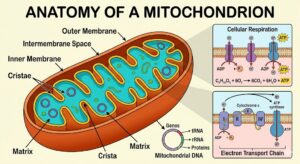
As you can see in the diagram above, a mitochondrion is uniquely built for this job. Its inner membrane is highly folded into structures called cristae. These folds vastly increase the surface area available for chemical reactions, essentially squeezing a massive, highly efficient factory floor into a microscopic package. Every heartbeat, muscle twitch, thought, and immune response is paid for by the ATP generated along these folds.
Beyond energy, they also play critical roles in:
- Regulating cell life cycles: They help decide when old or damaged cells need to be safely dismantled (a process called apoptosis).
- Managing heat production: Keeping your core temperature stable.
- Signaling: Helping cells communicate with one another.
The Ultimate Supply-and-Demand System
Here is where biology gets truly fascinating: not every cell gets the same amount of power.
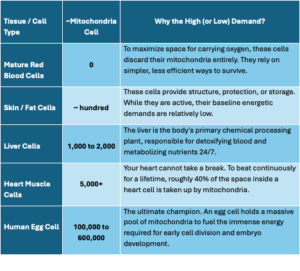
Your body operates on a strict supply-and-demand system. The number of mitochondria inside a single cell depends entirely on how much energy that specific tissue needs to do its job.
If a cell is sedentary, it gets a skeleton crew. If a cell works around the clock, it becomes an industrial powerhouse.
The Brain: A Special Case
While individual brain cells (neurons) contain thousands of mitochondria, the brain as a whole is an energy hog. It accounts for only about 2% of your body weight but consumes roughly 20% of your body’s total energy supply. Because neurons are constantly pumping ions back and forth to send electrical thoughts, they keep their mitochondria working overtime.
Fun Fact: You inherited them all from Mom
Unlike the DNA in your cell’s nucleus—which is a 50/50 split between your parents—mitochondrial DNA is entirely maternal. The mitochondria in the father’s sperm are typically destroyed during fertilization, meaning every single power plant currently running in your body is a direct copy of your mother’s.
How to Up-Regulate Your Personal Power Plants
The coolest thing about mitochondria is that their numbers aren’t permanently fixed. You can actually trigger your body to grow more of them and make your existing ones stronger through a process called mitochondrial biogenesis.
When you push your body through intense exercise or periods of fasting, your cells notice the sudden energy deficit. In response, they signal the body to build more factories to handle the future workload.
- Zone 2 Cardio & HIIT: Long, steady endurance training (Zone 2) forces your body to become highly efficient at burning fat for fuel, which strengthens mitochondria. High-Intensity Interval Training (HIIT) forces rapid ATP production, stimulating the growth of new ones.
- Quality Sleep: While you sleep, your brain activates a cleanup crew to clear out metabolic waste, allowing your mitochondria to repair themselves.
- Nutrient-Dense Diet: Mitochondria require specific micronutrients to convert food to energy effectively, including Ubiquinol® (Active form of CoQ10), magnesium, alpha-lipoic acid, and B vitamins.
Ultimately, taking care of your mitochondria is the secret to sustaining high energy levels, metabolic health, and longevity. When you fuel your body correctly and challenge it with physical movement, you’re quite literally building a more powerful engine from the cellular level up.