

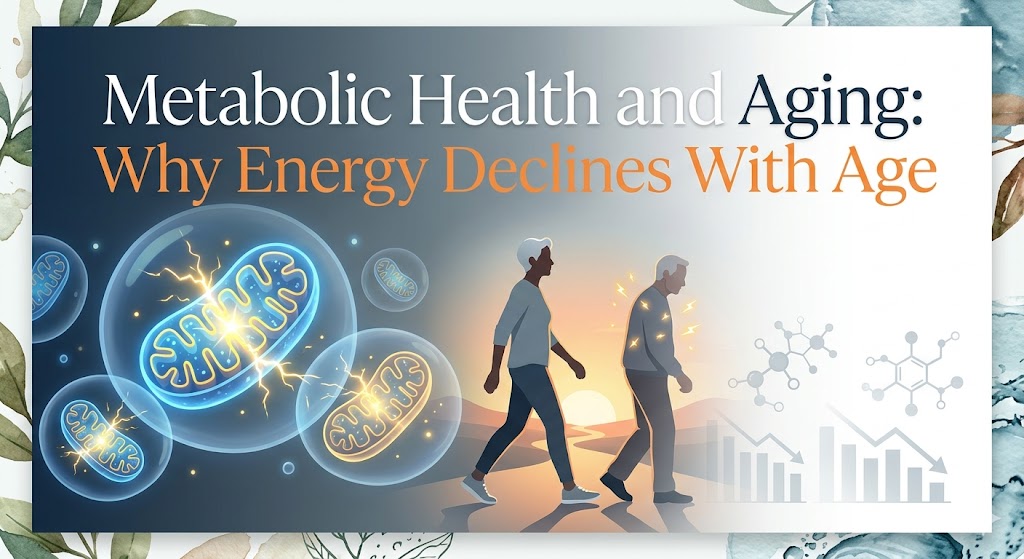
Ever wonder why you can’t bounce back from a late night or a heavy meal the way you used to? Many people chalk it up to “just getting older,” assuming that a sluggish metabolism and lower energy are an inevitable part of aging. But if you look beneath the surface at the cellular level, there is a specific biological reason for this shift.
The relationship between how we age and how our bodies handle energy comes down to two closely related concepts: age-related mitochondrial decline and the loss of metabolic resilience. By understanding how these systems slow down, we can identify science-backed, targeted ways to revitalize them.
The Root of the Slump: Cellular Power Plants and Mitochondrial Decline
To understand why energy declines as the years go by, we need to look inside our cells at tiny structures called mitochondria. Think of your mitochondria as microscopic power plants. Their primary job is to take the food you eat and the oxygen you breathe and convert them into cellular fuel known as ATP. When you are young, these power plants are abundant, efficient, and highly responsive.
As we age, our mitochondria naturally decline. Over time, they accumulate wear and tear, becoming less efficient at producing energy. Imagine a power grid running on decades-old equipment that begins to sputter, misfire, and produce less electricity. Because your cells are starved of optimal fuel, you experience this cellular brownout as baseline fatigue, reduced physical stamina, and a general feeling that your internal battery won’t hold a full charge.
Losing Your Snap: What is Metabolic Resilience?
This drop-off in cellular energy directly triggers a secondary problem: a loss of metabolic resilience. Metabolic resilience is your body’s ability to bounce back and restore balance after a challenge, such as a high-carb meal, a stressful day, or a period of physical exertion.
When you have high metabolic resilience, your body easily processes blood sugar, burns fat for fuel, and regulates hormones smoothly. But when mitochondrial energy declines, that flexibility disappears. Instead of efficiently clearing sugar from your blood or burning stored fat, your body struggles to adapt.
A high-carb meal that once gave you quick energy now leaves you exhausted for hours. This lack of bounce-back capacity makes it easier to gain visceral fat (the stubborn, unhealthy fat around your midsection) and harder to maintain steady blood sugar levels throughout the day.
Fortunately, cutting-edge nutritional science offers ways to fight back by targeting both sides of the coin: revitalizing cellular powerhouses and restoring metabolic flexibility.
Phase 1: Recharging Your Cellular Batteries
To restore your youthful energy, you need to support the structure and function of the mitochondria. Several clinically studied, branded nutraceutical ingredients are designed to do exactly that:
- Kaneka Ubiquinol®: Ubiquinol® is the active, antioxidant form of Coenzyme Q10 (CoQ10). It resides directly within the mitochondrial membrane, serving as a crucial spark plug in the electron transport chain that generates ATP. As we age, our bodies become much less efficient at converting standard CoQ10 into Ubiquinol®. Supplementing directly with this advanced form protects cells from oxidative stress and helps maintain steady, fluid cellular energy production.
- Urolithin A: Your body has a built-in cellular recycling system called mitophagy, which clears away damaged, sputtering mitochondria so healthy ones can thrive. Urolithin A is a widely discussed compound that activates this exact cleanup process. Sweeping away the “junk” power plants helps pave the way for a more efficient cellular landscape.
- PQQ (Pyrroloquinoline Quinone): While ingredients like Ubiquinol optimize existing mitochondria, PQQ promotes mitochondrial biogenesis—the formation of new mitochondria within aging cells. More power plants mean a greater capacity for overall energy production.
Phase 2: Restoring Metabolic Balance and Resilience
Once you address energy production at the foundation, you can tackle how your body utilizes that energy. Modern research has identified several highly specialized botanical ingredients that target blood sugar, fat storage, and metabolic hormones:
- Dyglomera® & CQR-300®: These two standardized botanical extracts are making waves for their ability to naturally support GLP-1 pathways. GLP-1 is a key gut hormone that signals satiety to the brain and helps regulate insulin sensitivity. Clinical data show that these ingredients help reduce body fat, curb excess calorie intake, and improve fasting glucose levels by naturally optimizing the body’s metabolic signaling.
- Altilix®: This specific, polyphenol-rich extract derived from artichoke leaves works heavily on cardiometabolic markers and liver health. Clinical trials show it helps manage body weight, waist circumference, and HbA1c (a key long-term marker of blood sugar management) by supporting the body’s processing of lipids and carbohydrates.
- Fenuflakes® & Torabolic®: Both derived from fenugreek seeds, these ingredients address metabolism from distinct angles. Fenuflakes® is a specialized, neutral-tasting fiber-and-protein matrix that lowers the glycemic index of foods and supports gut health by promoting a diverse microbiome. Torabolic®, a highly purified extract, acts at the tissue level, activating AMPK (the body’s master metabolic switch) to enhance glucose uptake in muscles, helping shift body composition away from fat accumulation and toward lean mass.
The Lifestyle Synergy: Supporting the Foundation
While advanced nutraceuticals offer targeted, precision support, they work best when paired with the everyday habits that inherently support our mitochondria and metabolism. To maximize your results, incorporate these core lifestyle strategies:
Smart Movement
Incorporate a mix of resistance training and zone 2 cardio (steady, moderate-intensity exercise at which you can still hold a conversation). Exercise acts as a positive stressor that forces cells to adapt by building more mitochondria and driving glucose into muscle tissue without relying heavily on insulin.
Strategic Eating
Avoid continuous grazing, which keeps insulin levels elevated and prevents the body from switching to fat-burning mode. Focus on whole foods rich in lean proteins, healthy fats, and prebiotic fiber to keep blood sugar stable.
Prioritize Rest
Deep sleep is when cellular repair peaks and the brain and body clear metabolic waste. Aim for seven to eight hours of quality sleep to prevent a spike in cortisol (the stress hormone) that can disrupt glucose metabolism the next day.
The Bottom Line
Aging does alter our internal biochemistry, but a decline in vital energy doesn’t have to be your baseline. By combining fundamental lifestyle habits with science-backed, targeted ingredients that protect the mitochondria and restore metabolic flexibility, you can give