

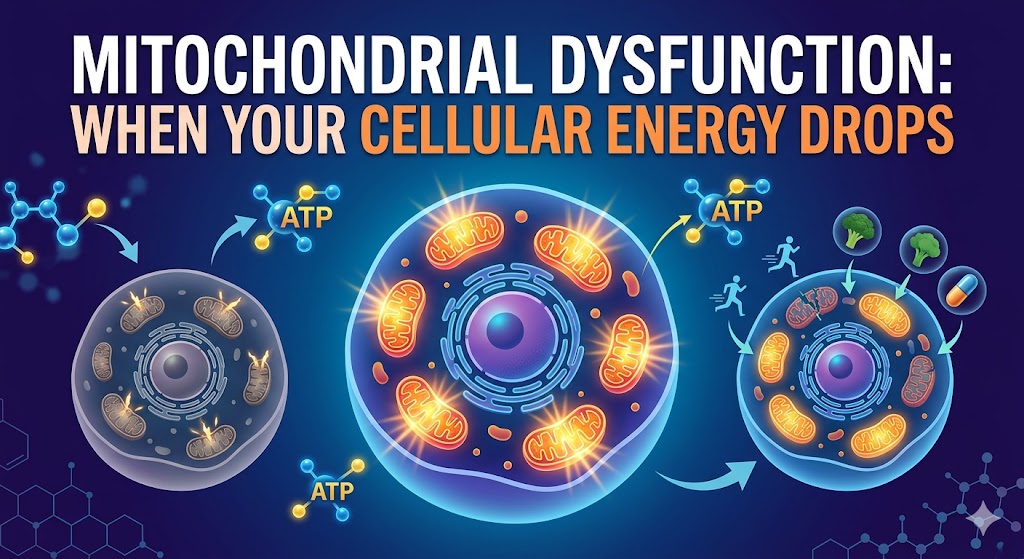
Ever feel like your body’s battery is draining faster than it used to? You get plenty of sleep, you drink your coffee, but that vibrant, bounce-back energy just isn’t there.
The culprit might not be your schedule; it might be your mitochondria. To understand why your energy levels dip as the years go by, we have to look beyond the surface and zoom into your cells.
The Powerplants of Your Body
Think of mitochondria as your body’s personal energy factories. Found in almost every cell, their main job is to take the food you eat and the oxygen you breathe and turn them into ATP, the universal energy currency your cells need to function.
When you’re young, these factories run like a finely tuned machine. They pump out ATP efficiently, keeping your physical and mental stamina high.
Healthy Mitochondria = Youthful Energy
But as we age, these vital powerplants start to experience wear and tear. They become less efficient, less productive, and a bit prone to “pollution.” When your cellular energy factories slow down, it triggers a domino effect known as mitochondrial dysfunction.
The Ripple Effect of Cellular Sluggishness
When your mitochondria aren’t running at 100%, your entire body feels the deficit. Here is what happens when your cellular energy drops:
- You Feel Tired More Often: Without adequate ATP production, everyday tasks start to feel like an uphill battle. The baseline exhaustion doesn’t just disappear with a quick nap.
- Slower Recovery Times: Whether it’s bouncing back from a tough workout, a long work week, or a minor illness, your cells need energy to repair themselves. Less fuel means a longer road to recovery.
- Reduced Stamina: You might notice you run out of gas much quicker during physical activities or demanding mental tasks than you used to.
- More Cellular Stress: Inefficient mitochondria don’t just produce less energy; they also generate more “smoke.” In the cellular world, this smoke takes the form of free radicals, by-products that cause oxidative stress and damage your cells from the inside out.
How to Supercharge Your Cellular Factories
Here is the good news: you aren’t powerless against mitochondrial decline. You can actively support your cellular health and revitalize your energy production with a few deliberate lifestyle choices.
Move Your Body
Exercise is one of the most powerful triggers of mitochondrial biogenesis, which is just a fancy way of saying “creating new mitochondria.” Both high-intensity interval training (HIIT) and consistent resistance training signal your body that it needs more power plants, prompting it to build them.
Feed Your Cells the Right Nutrients
Your mitochondria require specific vitamins and minerals to convert food into energy. A diet rich in antioxidants, leafy greens, healthy fats (such as omega-3s), and lean proteins provides the structural building blocks your cells need while helping to neutralize those stressful by-products.
Consider Targeted Supplements
Sometimes, your diet needs a little support. Certain supplements are highly regarded for their ability to directly support mitochondrial function and protect mitochondria from oxidative stress:
- Kaneka Ubiquinol® An essential enzyme that helps transfer electrons in the ATP-making process.
- Alpha-Lipoic Acid (ALA): A potent antioxidant that works inside the mitochondria.
- NAD+ Boosters (like NMN or NR): Compounds that help maintain the cellular communication channels critical for energy metabolism.
The Bottom Line: Turn the Lights Back On
Aging is inevitable, but feeling completely drained doesn’t have to be. By understanding that your energy begins at the cellular level, you can make daily choices that support, protect, and multiply your body’s power plants.
Invest in your mitochondria today, and reclaim the youthful stamina you need to thrive.