

We’ve all faced that moment during a workout when the “wall” shows up. Your heart races, your lungs burn, and suddenly, your legs feel like lead. Most of us blame our muscles or lack of willpower, but the real reason is often much simpler.
Physical fatigue usually begins at the cellular level, specifically, inside your mitochondria.
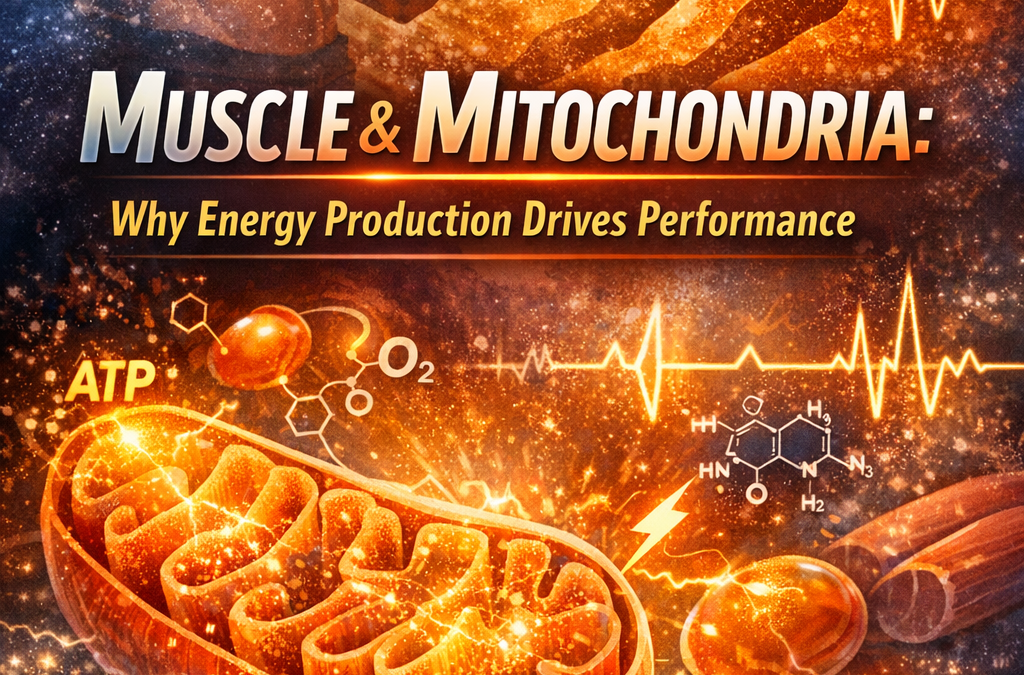
Known as the “power plants” of the cell, mitochondria are responsible for producing Adenosine Triphosphate (ATP), the universal energy currency of your body. When your mitochondria can’t keep up with the demand for ATP, your performance doesn’t just slow down; it stops. Here is how energy production drives performance and how you can optimize your cellular engines.
The Mitochondrial “Burnout”: Why We Fatigue
During intense exercise, your mitochondria are working at a furious pace to convert fuel (fats and sugars) into energy. However, this process isn’t perfectly clean. It produces metabolic “smoke” known as Reactive Oxygen Species (ROS).
If this “smoke” isn’t cleared away, it damages the mitochondria, leading to:
- Reduced ATP Output: Your muscles lose their “spark.”
- Delayed Recovery: Damaged mitochondria take longer to repair after a session.
- Chronic Fatigue: You start the next workout already at a deficit.
The Mitochondrial Toolkit: Key Ingredients for Energy
To keep the power plants running at peak efficiency, we need to focus on fuel transport, electron efficiency, and antioxidant protection.
The Spark Plug: Kaneka Ubiquinol®
Within the mitochondrial membrane, there is a critical step called the Electron Transport Chain. Ubiquinol® (the active, antioxidant form of CoQ10) is the “spark plug” that allows this chain to move electrons efficiently.
- The Performance Edge: Without sufficient Ubiquinol®, the process of making ATP slows. Supplementing ensures that your “engines” can fire consistently, even under heavy loads.
The Architect: PQQ (Pyrroloquinoline Quinone)
If Ubiquinol is the spark plug, PQQ is the architect. It is one of the few nutrients known to support mitochondrial biogenesis—the creation of new mitochondria.
- The Performance Edge: More mitochondria mean a higher capacity for energy production. It’s like upgrading your car from a 4-cylinder engine to a V8.
The Fuel Truck: L-Carnitine
Your mitochondria prefer to burn fatty acids for long-term energy, but those fats can’t get into the mitochondrial “furnace” on their own. L-Carnitine acts as the delivery truck that shuttles these fats across the cell membrane.
- The Performance Edge: By improving fuel delivery, you spare your limited glycogen (sugar) stores, allowing you to go longer before “bonking.”
Coolant: ReDaxin®
High-performance engines generate a lot of heat. ReDaxin® acts as the specialized “coolant” for your cells. It is designed to neutralize the ROS (oxidative stress) produced during heavy training.
- The Performance Edge: By protecting the mitochondria from being damaged by their own energy production, ReDaxin® helps maintain power output for longer durations and significantly speeds up post-workout recovery.
The “Total Energy” Synergy: Better Together
When you combine these ingredients, you address the entire lifecycle of cellular energy:
- PQQ builds the engines (Quantity).
- Ubiquinol® optimizes the spark (Efficiency).
- Acetyl-L-Carnitine delivers the fuel (Throughput).
- ReDaxin® manages the exhaust (Protection).
This multi-pronged approach ensures that your muscles have a constant, clean supply of ATP. It’s the difference between a muscle that fatigues after 10 reps and one that is ready for 12.
Power Your Performance from Within
Elite performance isn’t just about how much you can lift; it’s about how much energy your cells can produce. By focusing on mitochondrial health with high-performance nutrients like Ubiquinol®, PQQ, L-carnitine, and ReDaxin®, you are upgrading your body’s most fundamental power source. Don’t just train your muscles. Fuel your mitochondria, and watch your performance reach a new gear.