

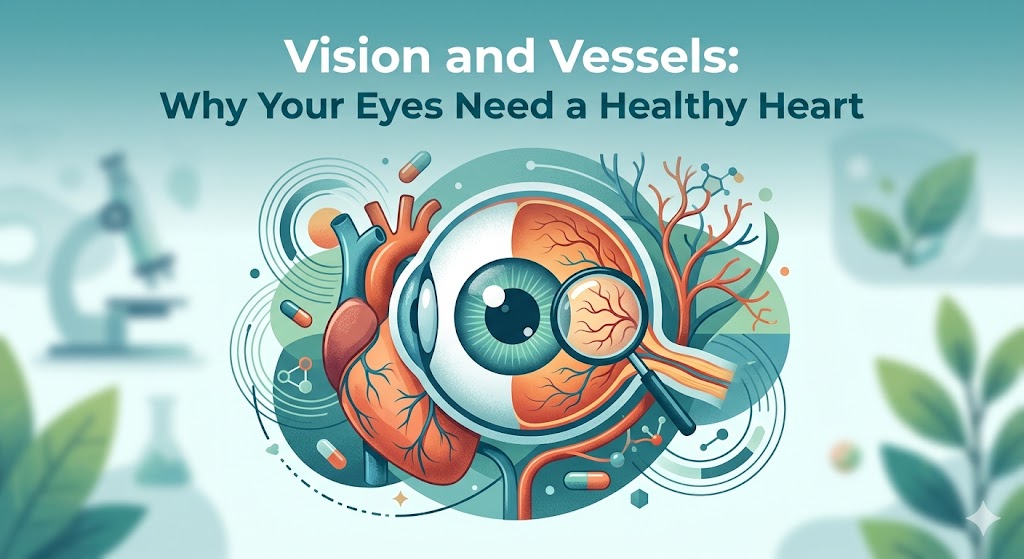
We often hear that the eyes are the “window to the soul,” but in clinical medicine, they are actually the window to your cardiovascular system. Most people think of eye and heart health as entirely separate concerns. One belongs to the ophthalmologist, the other to the cardiologist. But your body doesn’t draw that line. The retina, the delicate tissue lining the back of your eye, is home to some of the smallest and most fragile blood vessels in your body. And those tiny capillaries are often the first to show damage when something goes wrong with your cardiovascular system.
The retina is one of the most metabolically active tissues in the human body, requiring a constant and robust supply of oxygen and nutrients. To meet this demand, it relies on a dense network of tiny capillaries. Because these vessels are so small and sensitive, they are often the “canaries in the coal mine”, showing the first signs of damage from high blood pressure or poor circulation long before symptoms appear elsewhere in the body.
The Retina: A Window into Your Cardiovascular Health
The retina is the only place in the body where doctors can directly observe living blood vessels without surgery. That’s why a routine eye exam can sometimes reveal cardiovascular problems before any other symptoms appear.
When blood pressure remains high or blood vessels stiffen with age and plaque buildup, the retina’s delicate capillaries are among the first to suffer. This condition, known as hypertensive retinopathy, occurs when sustained high blood pressure damages the small arteries that feed the retina. The vessels narrow, leak, and eventually lose their ability to deliver oxygen and nutrients to retinal tissue. Early signs include arteriolar narrowing and arteriovenous nicking, subtle changes your eye doctor can spot during a dilated exam. In more advanced stages, hemorrhages and cotton wool spots appear.
The changes observed in retinal blood vessels often mirror damage occurring simultaneously in the kidneys, heart, and brain. People diagnosed with hypertensive retinopathy carry a significantly higher risk of developing coronary heart disease and stroke. In other words, when the retina’s capillaries are in trouble, it’s a signal that blood vessels throughout the body may be struggling too.
This is why protecting your vision isn’t just about your eyes; it’s about supporting the entire circulatory system that nourishes them.
Phase 1: Protecting the Vision (Ocular Support)
The retina is highly susceptible to oxidative stress, partly because it has one of the highest metabolic rates of any tissue in the body. Targeted nutritional support can help protect retinal cells and the delicate vasculature that serves them.
- CaroRite® & Lute-Gen®: These provide a full spectrum of carotenoids, including Lutein and Zeaxanthin. These nutrients migrate to the macula to form “internal sunglasses,” filtering harmful blue light and neutralizing free radicals that can damage retinal cells.
- Bilberry Extract: Famous for its use by WWII pilots, Bilberry is rich in anthocyanosides. These compounds strengthen capillary walls and improve rhodopsin regeneration, which is vital for night vision and adapting to light changes.
- Astaxanthin: Astaxanthin can deliver its protective effects directly to the retina and the ciliary muscles that control focusing. Studies suggest astaxanthin helps reduce eye fatigue, supports blood flow to ocular tissues, and provides broad-spectrum antioxidant protection that complements the macular carotenoids found in CaroRite® and Lute-Gen®.
Phase 2: Strengthening the Vessels (Cardiovascular Support)
Because the retina depends on healthy circulation, supporting cardiovascular function is a direct investment in your vision. The following ingredients target the key cardiovascular concerns, blood pressure, blood flow, oxidative stress, and vascular flexibility, that most directly impact the tiny vessels feeding your eyes.
- ABG10+® (Aged Black Garlic): This specialized extract is standardized to S-allyl cysteine (SAC). It helps maintain healthy blood pressure levels and supports the elasticity of the vascular system, reducing the “pressure” exerted on those delicate ocular capillaries.
- NSK-SD® (Nattokinase): A powerful enzyme that supports healthy blood flow and viscosity. Ensuring blood flows smoothly through the smallest vessels helps prevent blockages that can lead to retinal complications.
- Kaneka Ubiquinol® (Active CoQ10): The heart is an energy hog. Ubiquinol® provides the cellular fuel (ATP) necessary for the heart muscle to pump efficiently while acting as a potent antioxidant to protect the vessel lining.
- Magnesium (Malate or Glycinate): Often called the “master mineral,” magnesium helps the smooth muscles of the blood vessels relax, facilitating better systemic circulation.
- Omega-3 Fatty Acids (EPA and DHA): EPA and DHA support cardiovascular health by helping to maintain healthy triglyceride levels, reducing systemic inflammation, and promoting arterial flexibility. At the same time, DHA is a major structural component of the retina itself, particularly the photoreceptor cells that convert light into the signals your brain interprets as vision. This dual role makes omega-3s one of the most natural bridges between cardiovascular and ocular support.
The Combined Approach: Why Synergy Matters
While taking a single ingredient is helpful, a “Vision and Vessels” protocol is far more powerful. Here is why:
- Micro-Macro Synergy: While ingredients like ABG10+® and NSK-SD® optimize the “macro” circulation (the big pipes), Bilberry and CaroRite® or Lute-Gen® optimize the “micro” environment (the tiny capillaries). Together, they ensure nutrients actually reach the target tissue.
- Oxidative Protection: The eye is highly susceptible to light-induced oxidation, while the heart is susceptible to metabolic oxidation. Combining Kaneka Ubiquinol® with CaroRite® provides a multi-layered antioxidant shield that protects both the pump and the lens.
- Blood Flow Efficiency: Improving the strength of the heartbeat (Ubiquinol®) and the smoothness of the blood (Nattokinase) makes the job of the retinal antioxidants (Lute-Gen®) much easier, as they can be delivered more effectively to the macula.
The Bottom Line
Your eyes and your heart are not independent systems; they are a continuous loop. If you are concerned about your vision, look at your blood pressure. If you are concerned about your heart, keep an eye on your retinal health. By combining vessel-strengthening nutrients with eye-specific antioxidants, you are practicing true systemic prevention.