

Think of your skin, joints, and bones as a high-end skyscraper. To stay upright and flexible, that building needs a sturdy internal frame. In the human body, that frame is collagen.
As the most abundant protein in your body, collagen is the “glue” that holds everything together. But as we age, that glue starts to lose its grip. Here is the breakdown of why collagen matters, why it fades, and how you can protect your internal architecture.
The Collagen Matrix: Your Body’s Internal Scaffolding
Collagen doesn’t just float around; it forms a sophisticated collagen matrix. Imagine a dense, 3D web of fibers that provides structure to your skin and cushioning to your joints.
The Role of Cross-Linking
To strengthen this matrix, collagen fibers undergo cross-linking. This cross-linking gives collagen its strength and resilience, but it’s a double-edged sword. Over time, excessive cross-linking, often accelerated by exposure to sugars and certain environmental stressors, can make collagen fibers stiff and brittle. This process is largely driven by advanced glycation end products (AGEs), molecules formed when proteins or fats combine with sugars in the bloodstream. AGEs can accumulate and impair collagen function, contributing to visible signs of aging and decreased tissue flexibility.
This makes the fibers brittle and stiff, leading to wrinkles and creaky joints.
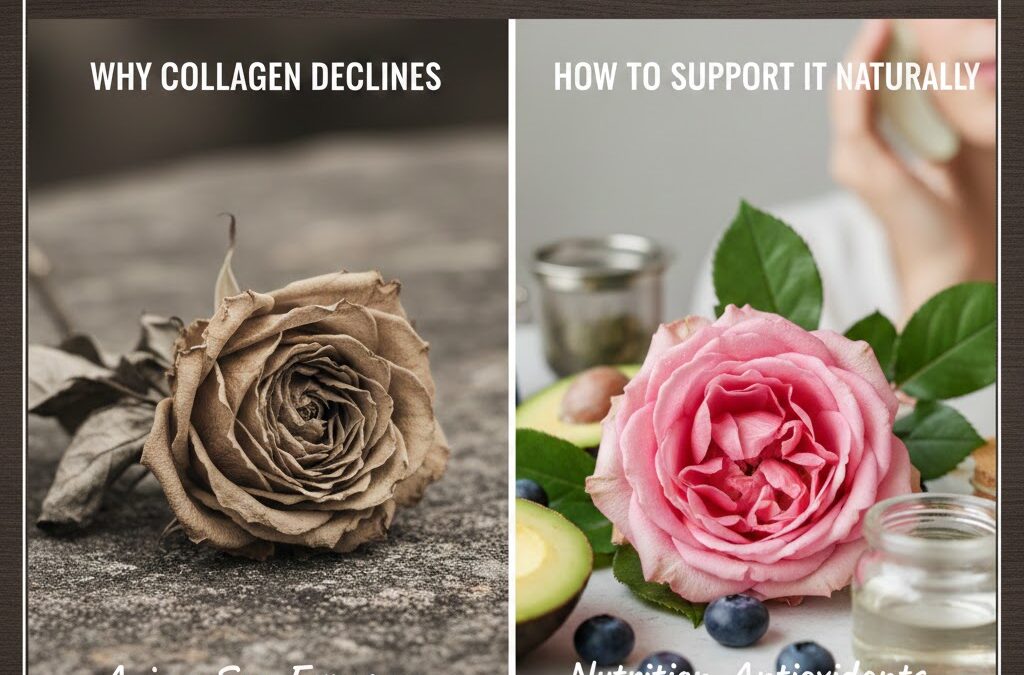
Why Does Collagen Decline?
It’s a two-front war: Natural Aging and Lifestyle Factors.
- The Biological Clock: Starting in our mid-20s, we lose about 1% of our collagen each year.
- Photoaging: UV rays from the sun act like a pair of scissors, shredding the collagen matrix.
- Oxidative Stress: Pollution and poor diet create free radicals that attack protein structures.
- Inflammation: Constant “inflammaging” breaks down the scaffolding faster than your body can repair it.
How to Support Your Collagen Naturally
You can’t stop the clock, but you can give your body the tools to maintain its “building materials.”
The Power of Peptides
Eating a whole steak won’t necessarily send collagen straight to your skin. Collagen peptides are “pre-digested” (hydrolyzed) fragments that are small enough for your body to absorb. They act as a signal to your cells to start producing more of the good stuff.
The Hyaluronic Acid Matrix Connection: Dermial®
Collagen provides structure, but it requires moisture to remain pliable. Dermial® is a unique ingredient rich in hyaluronic acid and glycosaminoglycans. It helps lubricate the collagen matrix, ensuring your skin and joints stay hydrated and supple rather than dry and brittle.
Essential Co-Factors: Vitamin C
Vitamin C is the “project manager” of collagen synthesis. Without it, your body cannot physically cross-link the amino acids into functional collagen fibers. It is the essential spark for the whole process.
The Antioxidant Shield: CaroRite®
To prevent the “scissors” from cutting your collagen, you need internal sun protection and antioxidants. CaroRite® is a complex of mixed carotenoids (lutein, zeaxanthin, lycopene, and alpha and beta carotene) that provides a broad spectrum of protection against oxidative stress.
Strengthening the Barrier: Ceramides
While collagen works deep in the dermis, ceramides work on the surface. They seal the skin barrier, preventing “transepidermal water loss.” When your barrier is strong, your internal collagen is better protected from environmental stressors.
Maintaining your collagen is all about protection and replenishment. By combining the right structural building blocks with powerful antioxidants, you can keep your body’s “skyscraper” standing tall and flexible for years to come.