

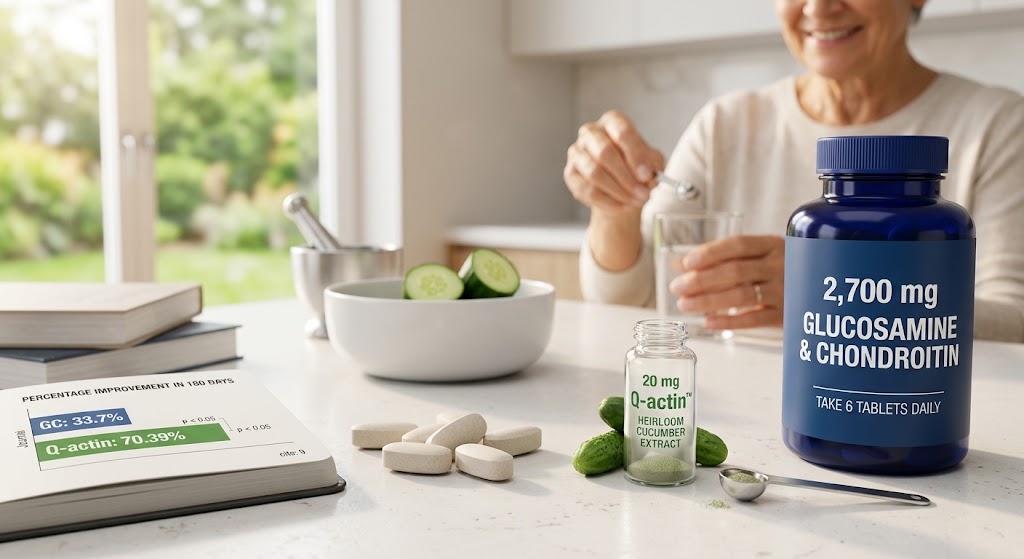
For years, glucosamine and chondroitin have been common supplements for stiff, aging knees. They often require three to six large tablets a day, which can become difficult to maintain. Even then, some people may wait months for results or notice little benefit.
Joint supplements are moving toward smaller, more targeted plant-based options. In a peer-reviewed clinical study, a patented cucumber extract called Q-actin® was tested at just 20 mg a day and produced greater improvements in joint comfort and movement than 2,700 mg a day of glucosamine and chondroitin.
What Is Q-actin®—and Why Isn’t Eating Cucumber the Same?
Q-actin® is a natural extract made from selected heirloom cucumbers (Cucumis sativus L.). Unlike common grocery-store cucumbers, these varieties contain a naturally occurring compound called ido-BR1. Modern cucumbers are often bred for size and shelf life rather than for preserving delicate plant compounds.
Rather than serving as a raw material for cartilage, ido-BR1 is described as altering how certain cells respond. It works with monocytes, a type of white blood cell, and may help limit excess TNF-α, a chemical messenger that can trigger enzymes that wear down cartilage and contribute to lasting joint discomfort.
Clinical Study: 20 mg of Q-actin® vs. 2,700 mg of Glucosamine-Chondroitin
Researchers tested Q-actin® in a six-month study conducted at several clinical sites. Participants were randomly assigned to a group, and neither they nor the researchers knew which treatment they received. The study was published in the peer-reviewed journal Clinical Interventions in Aging.
- Participants: 122 adults aged 40 to 75 with moderate knee osteoarthritis, enrolled at seven clinical sites.
- What each group took:
- Glucosamine-chondroitin group: 1,350 mg twice a day, for a total of 2,700 mg a day.
- Q-actin® group: 10 mg twice a day, for a total of 20 mg a day.
Results
WOMAC: Overall Joint Symptoms- WOMAC measures joint pain, stiffness, and difficulty with physical activities.
- After 30 days, WOMAC scores improved by 29.8% in the Q-actin® group and by 14.8% in the glucosamine-chondroitin group.
- After 180 days, overall joint symptoms improved by 39% with Q-actin®, compared with 33.7% with glucosamine and chondroitin.
VAS: Pain Level- VAS asks participants to rate their pain while resting and moving.
- Over six months, pain scores fell by 46% in the Q-actin® group. Q-actin® produced better results than glucosamine-chondroitin at every 30-day check.
LFI: Everyday Movement- LFI measures how joint problems affect everyday activities such as walking, climbing stairs, and standing up.
- After 180 days, LFI scores improved by 27% in the Q-actin® group, showing a meaningful improvement in everyday movement.
Why a Micro-Dose Works Better
How does an amount of powder that could easily fit inside the tip of a pencil outperform two large scoops of traditional joint supplements?
The difference is how each option works. Glucosamine and chondroitin provide materials the body may use to support cartilage, but the body must first absorb, process, and deliver them to the joints. When a joint is irritated, high levels of chemical messengers such as TNF-α can tell cells in the joint lining to release enzymes that break down cartilage. This may cause cartilage to wear away faster than the body can repair it.
Q-actin® works earlier in this process. Ido-BR1 may help control how much TNF-α the body produces and limit the movement of certain white blood cells into the joint. This may slow the chain reaction that causes cartilage to break down, giving nearby tissues a chance to recover and helping the joint move more comfortably.
The Bottom Line
In this six-month clinical study, a daily 20 mg dose of Q-actin® produced greater improvements in knee comfort, pain, stiffness, and everyday movement than 2,700 mg a day of glucosamine and chondroitin. The findings suggest that this concentrated heirloom cucumber extract may offer a lower-dose, easier-to-take option for adults seeking joint support.