

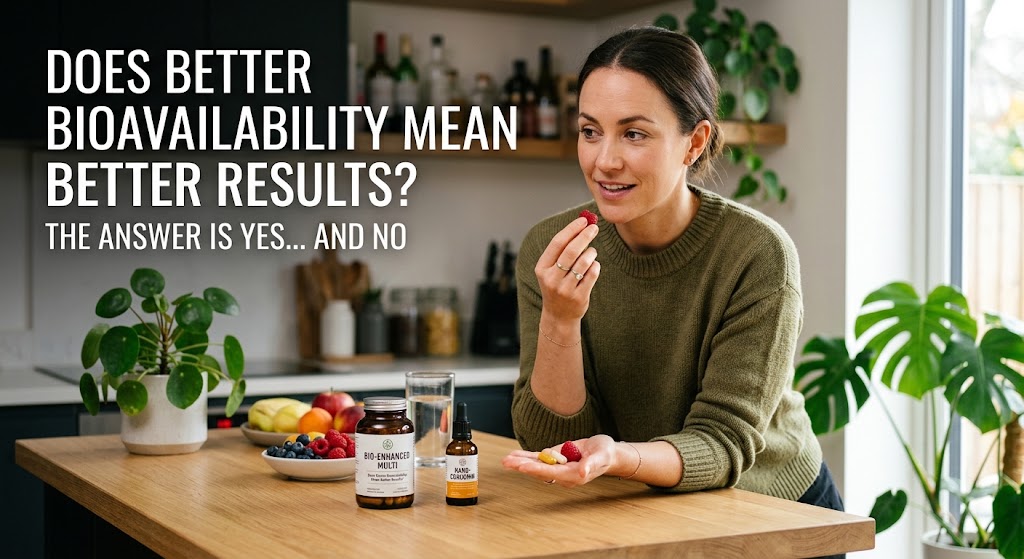
In the dietary supplement world, bioavailability has become one of the most powerful words in product development and marketing. Enhanced absorption. Greater bioavailability. More gets into the bloodstream. Those all sound like obvious advantages. And in many cases, they are. But there is an important question we don’t ask often enough:
Does increasing the bioavailability of an ingredient automatically make it more efficient or effective?
The answer is both yes and no.
Understanding why requires looking beyond how much of an ingredient gets into the bloodstream and asking a more important question: What happens after it gets there?
First, What Does Bioavailability Actually Mean?
Bioavailability generally refers to the fraction of an ingested substance that reaches systemic circulation in a form available to the body.
Imagine taking 500 mg of an ingredient. Not all 500 mg ends up circulating through your bloodstream. Some may never be absorbed. Some may be broken down in the digestive tract. Some may be metabolized by the intestinal wall or liver before reaching systemic circulation.
This is one reason supplement delivery technologies have become so important. Lipid-based systems, emulsions, micelles, phospholipids, nanoparticles, and other delivery approaches may help certain compounds overcome absorption barriers.
This brings us to the first side of the argument.
YES: Greater Bioavailability Can Mean Greater Efficiency
For ingredients whose effectiveness is limited primarily by poor absorption, improving bioavailability can make a tremendous amount of sense. Consider a compound that is poorly soluble and only a small percentage of which is normally absorbed. If a delivery technology substantially increases absorption, we may achieve greater systemic exposure from the same dose, or potentially a smaller one.
In that situation, improved bioavailability may translate into several practical advantages.
- More of the ingredient reaches circulation.If systemic exposure is important to the ingredient’s activity, getting more of it into circulation may increase the opportunity for it to exert its intended effects.
- Lower doses may become possible.If significantly more of an ingredient becomes available to the body, formulators may not need as much material to achieve a desired exposure level.
This matters because smaller doses can mean smaller capsules, fewer capsules per serving, smaller scoops, and potentially easier formulation into gummies, beverages, powders, and other consumer-friendly formats.
- Consistency may improve.Some advanced delivery systems aren’t simply designed to increase total absorption. They may also help reduce variability in absorption caused by factors such as whether a supplement is taken with or without food.
Bottom Line: Yes
When poor bioavailability is the bottleneck preventing an ingredient from doing its job, improving bioavailability may improve its efficiency.
But that’s only half the story.
On the No Side of Things
More in the Bloodstream Doesn’t Automatically Mean Better Results. This is where the conversation becomes much more interesting. We sometimes fall into the trap of assuming:
More absorption = more activity = better outcome.
Biology isn’t always that simple. Bioavailability is fundamentally a pharmacokinetic concept, i.e., what the body does with a compound, including its absorption, distribution, metabolism, and elimination. Effectiveness, on the other hand, is primarily about what the compound actually does in the body. These two concepts are related, but they are not interchangeable.
You could dramatically increase a compound’s blood concentration without proportionally improving the desired biological response. Why? Because absorption may not be the limiting factor.
Getting Through the Front Door Isn’t Enough
I like to think about bioavailability as getting someone through the front door of a building. If ten people are standing outside and only one gets through the door, widening that door so eight people can enter is obviously useful. But what if the job that needs to be done is on the tenth floor? Getting eight people through the front door doesn’t guarantee that any of them reach the tenth floor.
The same principle can apply to nutrients and bioactive compounds.
Once absorbed, an ingredient may still need to:
- Reach the appropriate tissue
- Cross biological membranes
- Remain stable long enough to act
- Be converted into an active metabolite
- Interact with a receptor, enzyme, or signaling pathway
- Reach a sufficient concentration at the target site
In other words, systemic bioavailability and biological effectiveness are not necessarily the same thing.
Sometimes Metabolism Is Part of the Benefit
There is another wrinkle. We often think of metabolism as the enemy of bioavailability. A compound gets metabolized, so less of the original compound appears in circulation. But what if those metabolites are biologically important?
Digestive enzymes, intestinal cells, the liver, or even the gut microbiome can transform some nutrients and plant compounds into metabolites that may contribute to their physiological effects. In those situations, focusing exclusively on increasing blood levels of the parent compound may give us an incomplete picture. Sometimes the journey through the digestive system and metabolism isn’t simply an obstacle.
More Isn’t Always Better
There is also the concept of a biological ceiling. Suppose doubling systemic exposure produces a meaningful improvement in a biological response. Does increasing exposure tenfold produce five times the benefit? Not necessarily.
Many biological systems demonstrate what is called a dose-response relationship, and that response frequently isn’t linear. At some point, receptors may become saturated. Enzymes may reach capacity. Transport systems may have limits. The body may increase elimination. Or the desired biological effect may simply plateau.
EXAMPLE: Think of watering a plant.
If a plant is dry, adding water makes an enormous difference. Adding twice as much water doesn’t make the plant twice as healthy. Eventually, more water provides no additional benefit, and too much may even become counterproductive.
The same “more isn’t necessarily better” principle can apply to bioavailability.
The Question Shouldn’t Be “How Much More Is Absorbed?”
This is where I believe the supplement industry needs to evolve. A study showing that a delivery system produces 500% greater bioavailability sounds impressive. But as a pharmacist, my next question is: So what?
That isn’t meant dismissively. It is the scientific question that needs to come next.
- What did that increased exposure accomplish?
- Did it improve the intended biological response?
- Did the higher peak concentration matter?
- Did the ingredient remain in circulation longer?
- Did it reach the relevant tissue?
- Could a smaller dose produce the same outcome?
- Did the improved delivery change the consumer experience?
And ultimately:
- Did it produce a measurable benefit?
Those questions move the conversation from bioavailability toward what really matters: bioefficacy.
Bioavailability vs. Bioefficacy
This distinction may be one of the most important concepts in modern supplement formulation.
Bioavailability asks: How much gets into the body and becomes available?
Bioefficacy asks: What does the body actually do with it, and what biological effect does it produce?
Ideally, we want both.
A delivery technology that dramatically increases absorption and shows that improvement translates into meaningful biological outcomes tells a much stronger scientific story than absorption data alone. That is why research showing how the body absorbs, moves, breaks down, and eliminates an ingredient should work alongside clinical outcome research that shows what the ingredient actually does in the body.
When Increased Bioavailability Matters Most
Improving bioavailability matters most when something clearly keeps an ingredient from working as well as it could. For example, an ingredient may not dissolve well in water, may break down too quickly during digestion, may have trouble passing through the gut wall, or may be changed by the liver before enough of it reaches the bloodstream. In these cases, a well-designed delivery system may help the ingredient get past a real obstacle in the body. But the goal should not be simply to create the biggest number on a chart that shows how much of the ingredient gets into the body.
The goal should be to create the right exposure for the right ingredient to produce the desired biological effect; a very different mindset.
From “More” to “Better”
For years, the supplement industry has focused heavily on dosage. Then the conversation evolved toward absorption. I believe the next evolution is efficiency.
Instead of asking only: “How many milligrams are in the product?” We started asking: “How much actually gets absorbed?” Now we need to take the next step and ask: “How much of what is absorbed actually contributes to the desired outcome?”
The Bottom Line
So, does increasing bioavailability increase efficiency?
Yes, when bioavailability is the limiting factor and greater exposure translates into a meaningful biological response.
No, when increased blood levels don’t improve tissue delivery, biological activity, or the desired outcome.
The future of supplement science isn’t simply about getting more into the body. It’s about getting the right amount, to the right place, in the right form, for the right amount of time—to produce the right result. And that is the difference between being more bioavailable and being more bioeffective.
Pharmacist David Foreman
The Herbal Pharmacist®